Thirsty Work: The Trail Water Playbook That Keeps You Out of Trouble
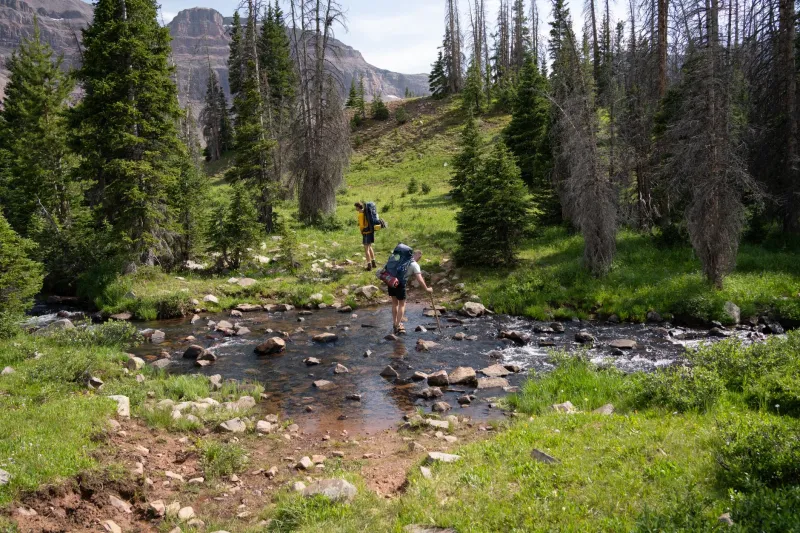
Ask any old-school backpacker what they worry about most and they won't say bears. They'll say water. You can shiver through a cold night and laugh about it later. You can run out of snacks and survive just fine. But run dry ten miles from the trailhead in July, and suddenly your trip becomes a very different story — one that usually ends with rangers and a very expensive bill.
The good news? Water smarts are learnable. Here's the full playbook.
Read the Land Before You Leave the Couch
Water planning starts weeks before you lace up your boots. Pull up the route on a topographic map — paper or digital — and hunt for the blue lines. But not all blue lines are created equal.
- Solid blue lines usually mean perennial streams that flow year-round.
- Dashed or intermittent lines mean seasonal flow. In spring, they're gushing. By August, they're a memory.
- Springs and seeps (marked with small symbols) are often the most reliable sources in dry country, since they're fed by groundwater rather than runoff.
Cross-reference with apps like Gaia GPS, onX Backcountry, or the FarOut comments section on popular thru-routes. Recent trip reports are gold — a "reliable creek" on a 2019 map might be a dry ditch today, especially with drought cycles hammering the West. If the most recent comment says "dry," believe it and plan around it.
The Desert Rule: Carry It or Skip It
If your trip takes you into the arid Southwest — think the Grand Canyon's rim-to-rim, Utah's canyon country, or sections of the Arizona Trail — flip your thinking entirely. Out there, you don't plan around water sources. You plan around water carries.
That means:
- Know the exact mileage between reliable sources. Not "probably a creek," but "17.3 miles to the next faucet."
- Budget roughly one liter per two hours of hiking in moderate temps, and double that when the thermometer cracks 90°F.
- Research seasonal water caches and spigots — places like the canyon water stations along the Bright Angel Trail or the spring boxes on the Colorado Trail's desert stretches.
- Consider stashing water caches yourself (legally, and always pack out the containers) on point-to-point routes.
Desert veterans call this "water discipline," and it's the single biggest skill separating confident Southwest hikers from search-and-rescue statistics.
Filters, Purifiers, and Chemicals: Pick Your Poison (Carefully)
Once you've found water, you've got to make it safe. Not all treatment methods are equal, and the right choice depends on where you're traveling.
Filters (Squeeze pumps, gravity bags, straw-style): These physically strain out bacteria and protozoa like giardia and cryptosporidium. They're fast, they don't taste like anything, and they're the workhorse for most US backcountry trips. The catch: they don't touch viruses, which are rarely a concern in American wilderness but matter in heavily used waterways downstream of cattle or human traffic.
Purifiers (UV wands, advanced filtration): Purifiers kill or remove viruses too. UV pens work great but require clear water, batteries, and a bit of faith. They're the right call for international travel or heavily trafficked river corridors.
Chemical treatment (iodine, chlorine dioxide tablets): Lightweight, cheap, and foolproof — but slow. Chlorine dioxide needs up to 30 minutes (and longer for crypto in cold water). Keep tablets as a backup in every pack, even if your primary system is a filter. Filters freeze, break, and clog. Tablets don't.
The pro move: run a filter as your primary and carry purification tablets as insurance. Combined weight penalty is a few ounces. Peace of mind is priceless.
Sourcing Smart in the Field
Even a great water source needs a little vetting. Follow these field rules:
- Collect from moving water when possible. Stagnant pools breed more nasties and often carry sediment that clogs filters fast.
- Draw from the source, not downstream of campsites. If you can see a fire ring or foot traffic 50 yards upstream, walk upstream yourself.
- Pre-filter murky water through a bandana or coffee filter before it hits your filter. Your hollow-fiber membrane will thank you with a longer life.
- Never drink untreated water — even that "crystal clear" alpine stream. Giardia doesn't care how pristine it looks, and mountain goats don't obey Leave No Trace.
Build a Water Plan, Not a Water Hope
The final layer is simply writing it down. Before any trip longer than a day, sketch out a quick water log: every known source, its reliability rating, the mileage between them, and your contingency if one is dry. Share it with someone at home.
That five minutes of planning is the difference between a trip where water is a background detail and one where it dominates every thought. Do the homework, pack the right treatment, and you'll spend your trail time looking at the views — not listening for running water.
Gear up. Get out. And drink well out there.