Chasing the Dark: Where to Camp Under America's Wildest Night Skies
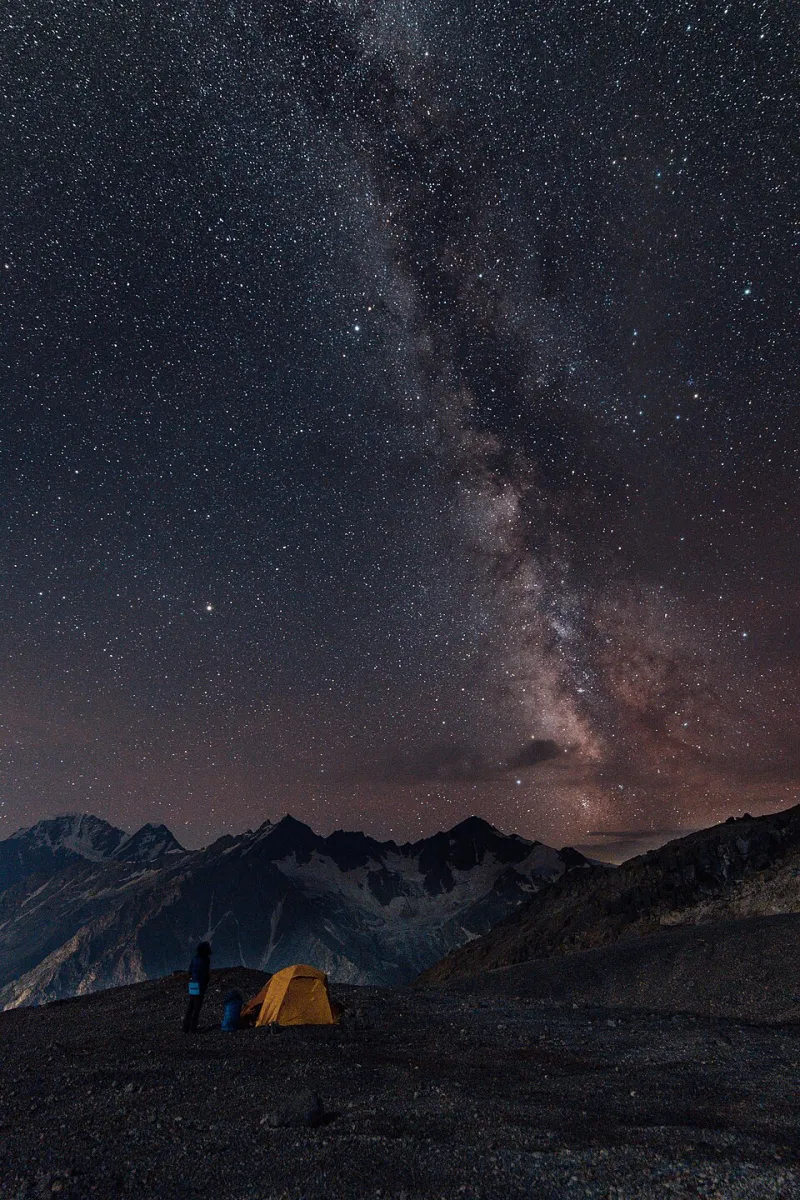
Photo: oliwok, CC BY 4.0, via Wikimedia Commons
Somewhere around 80 percent of Americans can't see the Milky Way from home. City glow, porch lights, billboards — the night sky got paved over while nobody was paying attention. But drive a few hours in the right direction, pitch a tent, and look up, and it all comes roaring back: the dusty river of the galaxy, satellites ticking across the dark, stars so dense they blur together.
Here's where to find that sky, and how to do it right.
Why the Moon Runs the Show
Before you book anything, check the lunar calendar. A full moon is beautiful, but it washes out the faint stuff — the Milky Way, the Andromeda galaxy, most meteor showers. You want the new moon, or the few nights on either side of it. Plan your trip around moonrise too: a moon that sets early gives you dark skies for the second half of the night.
Astronomy apps like PhotoPills or SkySafari take the guesswork out. Five minutes of planning beats standing in a field at midnight wondering why everything looks washed out.
Nine Campgrounds Worth the Drive
1. Great Basin National Park, Nevada — Remote doesn't begin to cover it. The nearest real town is hours away, and the park earned International Dark-Sky Park status for good reason. Camp at Upper Lehman Creek and you'll see the Milky Way cast a shadow on moonless nights. Yes, really.
2. Cherry Springs State Park, Pennsylvania — The East Coast's dark-sky refuge, sitting on a plateau surrounded by the 265,000-acre Susquehannock State Forest. Astronomers fly in from cities just to use the observing field. The campground is simple, but the sky is anything but.
3. Big Bend National Park, Texas — NPR once reported Big Bend has the least light pollution of any national park in the Lower 48. The Chisos Basin campground puts you in a natural bowl of rock with the entire galaxy overhead. Go in fall or spring — summer up there is brutal.
4. Headlands Beach State Park, Ohio — A certified Dark Sky Park on Lake Erie, of all places. Free entry, open all night, and a sandy shoreline that gives you a 180-degree horizon for meteor showers.
5. Natural Bridges National Monument, Utah — The first International Dark-Sky Park in the world. Small campground, thirteen sites, first-come-first-served. Show up early or take your chances.
6. Acadia National Park, Maine — The only national park on the East Coast with genuine dark-sky credentials. Sand Beach hosts a star festival every fall, and Cadillac Mountain's summit turns into an impromptu observatory on clear nights.
7. Death Valley National Park, California — The Gold Tier of dark-sky ratings. Furnace Creek campground keeps you close to the action, and the desert air is so dry and clear that winter camping works fine here.
8. Katahdin Woods and Waters National Monument, Maine — Newer, quieter, and darker than its famous neighbor Acadia. The Seboeis parcel has dispersed sites where you'll hear nothing but loons and see everything the galaxy has to offer.
9. Homer, Alaska — Kachemak Bay State Park — In summer, the sky barely darkens. But in September and October, the aurora borealis starts showing up, and camping under the northern lights rewrites your definition of a good night out.
Timing the Sky's Best Shows
The Perseids in mid-August are the reliable crowd-pleaser — 50 to 100 meteors an hour at peak, with warm-weather camping to match. The Geminids in December are actually stronger, but you'll need real cold-weather gear. The Quadrantids in early January are the sleeper hit: short, sharp, and spectacular if you catch the peak.
For the Milky Way itself, the galactic core is best visible from late March through early October, with June and July offering the richest views.
Red Lights, No Exceptions
Here's the etiquette part: your white-light headlamp is a weapon at a dark-sky site. It takes human eyes up to 30 minutes to fully adapt to darkness, and one flash of white light resets the clock for everyone around you.
A red-light headlamp fixes this. Most headlamps have a red mode — use it, and use it exclusively once the sun's down. Tape over any white LEDs that stay on in low mode. Your campmates, and every astrophotographer within a half mile, will thank you.
Phone Cameras Can Do More Than You Think
You don't need a $2,000 rig to bring home proof. Any modern smartphone with a manual or "pro" mode can capture the sky:
- Prop your phone on something solid — a tripod is ideal, but a rock and a jacket work
- Set a 5-10 second timer or use the volume button to avoid shake
- Drop ISO to 1600-3200 and shutter speed to 10-15 seconds
- Tap the sky to focus, then drag the exposure down
Longer than 15 seconds and you'll get star trails instead of pinpoints — which, honestly, can be its own cool effect. Play with it.
If you do graduate to a camera, a wide lens (14-24mm), f/2.8 or faster, and the 500 rule (500 divided by focal length = max shutter seconds) will get you started.
The Real Point
Nobody drives four hours into the desert or up a Maine logging road just to take a photo. They go because standing under an untouched sky does something to you. It re-scales things. The deadlines shrink, the noise quiets, and you remember the sky is supposed to look like this — we're the ones who turned it off.
Pick a new moon. Pack the red headlamp. Go get your dark back.