Two Miles to Silence: How to Earn Your First Backcountry Campsite
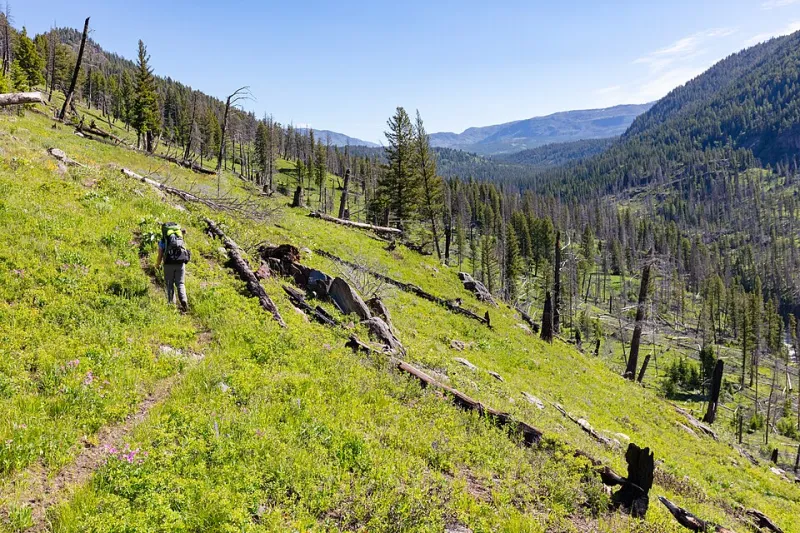
Photo: YellowstoneNPS, Public domain, via Wikimedia Commons
There's a moment that happens about a mile and a half up most approaches in America's national forests. The gravel road noise fades. The cooler-toting neighbors disappear. And you realize the only thing between you and a lakeside campsite with nobody else in sight is a little sweat and some smart packing.
If you've done your time at drive-up campgrounds — and there's nothing wrong with them — backpacking in can feel like a leap. It's not. It's a step. A few thousand of them, actually, but they're steps you can absolutely take this season.
Pick a Route That Wants You to Succeed
The biggest mistake first-timers make isn't packing too heavy or picking a bad campsite. It's choosing a route that fights back. Your first overnight should be boringly easy: two to four miles, minimal elevation gain, and a reliable water source near camp.
National forests are your friend here. Unlike marquee national parks, forests like Michigan's Ottawa, Georgia's Chattahoochee, or Colorado's Routt offer dispersed backcountry camping without permits, lottery systems, or reservation scrambles. Call the local ranger district — an actual human will often hand you a map, mark a loop, and tell you where the water runs in late summer.
A few non-negotiables for route selection:
- Under 1,500 feet of total gain for your first trip. Your legs will thank you at mile three.
- Water within a half-mile of camp, so you're not hauling a gallon up a ridge.
- A loop or shuttle-free out-and-back, so you're not managing a car shuttle on top of everything else.
- Cell coverage gaps you've mapped in advance, not discovered in a panic.
You Already Own Most of This
Here's a secret the gear industry doesn't advertise: the jump from car camping to backpacking requires buying almost nothing if your base kit is decent. Your two-person tent works fine carried by two people. Your camp stove — especially a small canister model — packs along just as happily at mile two as it does at site 47.
What actually matters is attacking the big three weight hogs:
- Sleep system. A car camping sleeping bag and air mattress are luxuries on the trail. A cheap closed-cell foam pad and a lighter bag (or even a quilt) can cut five pounds in one swap.
- Food packaging. Repackage everything into zip-top bags. That boxed mac and cheese weighs half as much without the box.
- The "just in case" pile. Lay everything out, then remove the camp chairs, the cast iron, the third flashlight, and the book you won't read.
A reasonable target for a first overnight is 30 pounds or less with water. Don't chase ultralight. Chase lighter than last time.
Water and Food: The Two Logistics That Matter
Everything else on a backpacking trip is comfort. Water and food are safety.
Plan on roughly half a liter per hour of hiking plus water for cooking — call it three liters per person per day in mild weather, more in the desert Southwest. Treat everything you collect, no matter how pristine that alpine stream looks. Giardia doesn't care how remote you feel. A squeeze filter covers most trips; chemical tablets make a great backup that weighs an ounce.
For food, think calorie density over cuisine. One night out means you can eat like a feral king: dehydrated meals, tortillas with peanut butter and honey, trail mix by the fistful. Rule of thumb is about 3,000 calories per person per day, and on your first trip, bring one extra meal. Hunger plus fatigue plus a navigation hiccup is a bad equation.
The Payoff Is Quieter Than You Think
Here's what nobody tells you about your first backpacking trip: the magic isn't the summit or the epic photo. It's the silence at 8 p.m. when the last day-hiker has gone home and the forest belongs to your headlamp and the crickets.
You'll hear barred owls instead of generators. You'll watch the Milky Way show up in stages instead of through haze. And you'll learn the deep satisfaction of a campsite you earned — one that required your own two feet to reach.
Start with two miles. That's it. Two miles past the trailhead, the crowds in most of America's public lands drop by ninety percent. Two miles past that, you might not see another human until morning.
Pack light, tell someone where you're going, and go find out what's been waiting just past the parking lot.


